
Can naturally occurring isotopes help distinguish between genuine reservoir-aquifer leakage and normal groundwater-rock interactions?
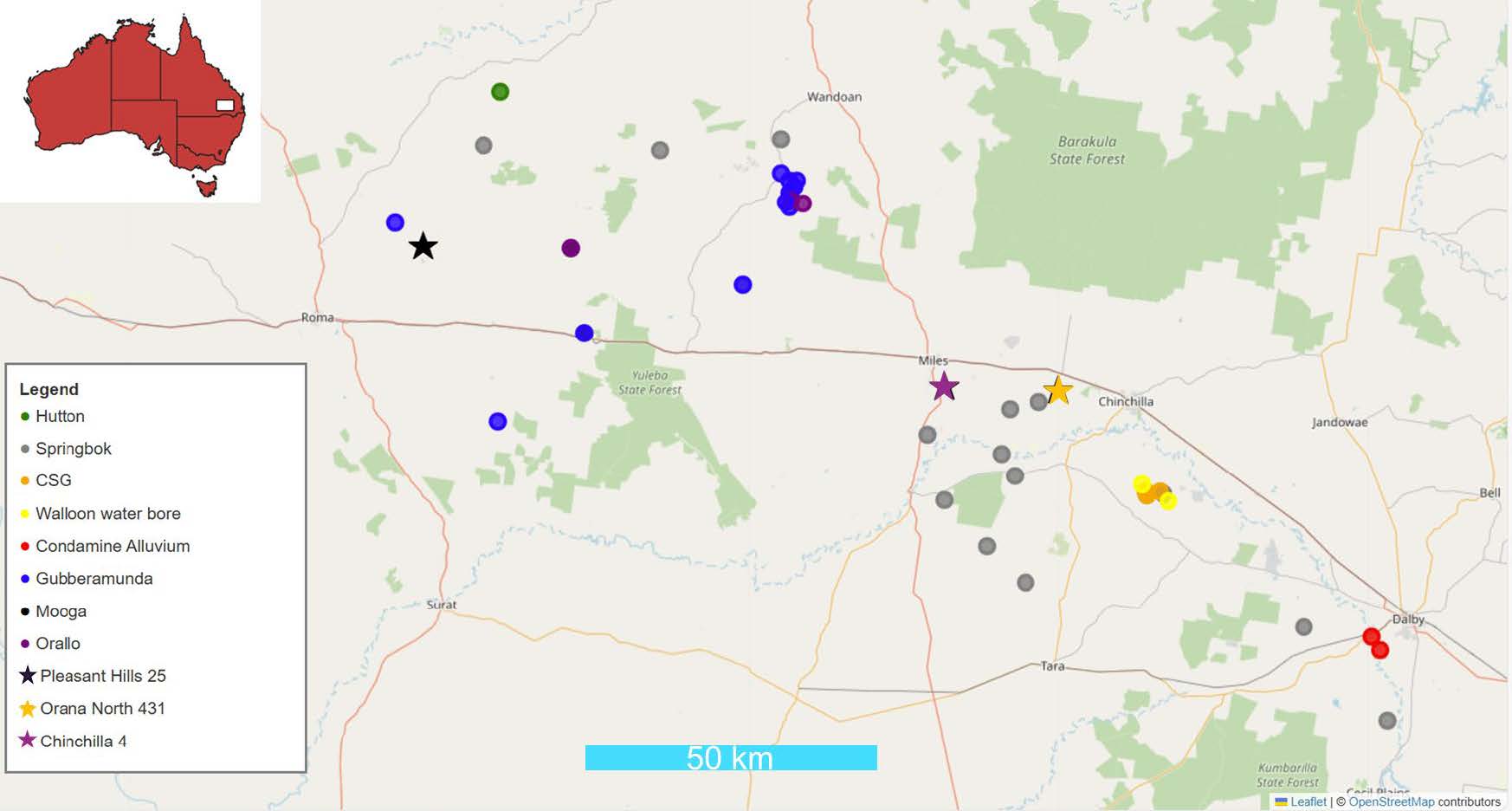
Groundwater tracers are increasingly used by regulators, governments and researchers to monitor potential connectivity between gas reservoirs and overlying aquifers. One such tracer is the strontium isotope ratio 87Sr/86Sr, which has been applied to assess whether groundwater in the overlying aquifer may be connected to the underlying coal seam gas reservoir.
In this project, researchers from the UQ Gas & Energy Transition Research Centre, in collaboration with the School of the Environment at The University of Queensland and the Australian National University, investigated whether overlapping 87Sr/86Sr signatures in groundwater are necessarily evidence of reservoir-aquifer connectivity in the Surat Basin's Springbok Sandstone aquifer and underlying Walloon Coal Measures coal seam gas reservoir. The work combined geological, geochemical and isotopic investigations to better understand the origin of strontium isotope signatures observed in groundwater.
Results showed that both the Springbok Sandstone and the Walloon Coal Measures contain a diverse range of minerals capable of contributing strontium to groundwater, including calcite cements and plagioclase-bearing minerals. Importantly, isotope signatures from both formations exhibited substantial overlap, particularly in the weak-acid extracts that best represent groundwater-rock interactions. The study found that the overlapping groundwater signatures previously observed between the two formations may be explained by their similar mineral compositions rather than by leakage between the reservoir and aquifer. This finding challenges the assumption that overlapping 87Sr/86Sr values alone constitute evidence of connectivity and highlights the need for careful interpretation of isotope data within a broader geological context.
By improving understanding of the processes that control groundwater isotope signatures, the research contributes to the development of more robust monitoring frameworks for gas-producing regions. The findings have implications not only for the Surat Basin, but also for other resource basins across Australia where isotope tracers may be used to assess groundwater protection and potential reservoir-aquifer interactions.
PROJECT OUTPUTS
- Final project report: Tracers for potential gas reservoir-aquifer leakage: 87Sr/86Sr (2026)
|