
What lessons from Queensland's coal seam gas industry can help governments, communities and project developers better manage the next wave of energy development?
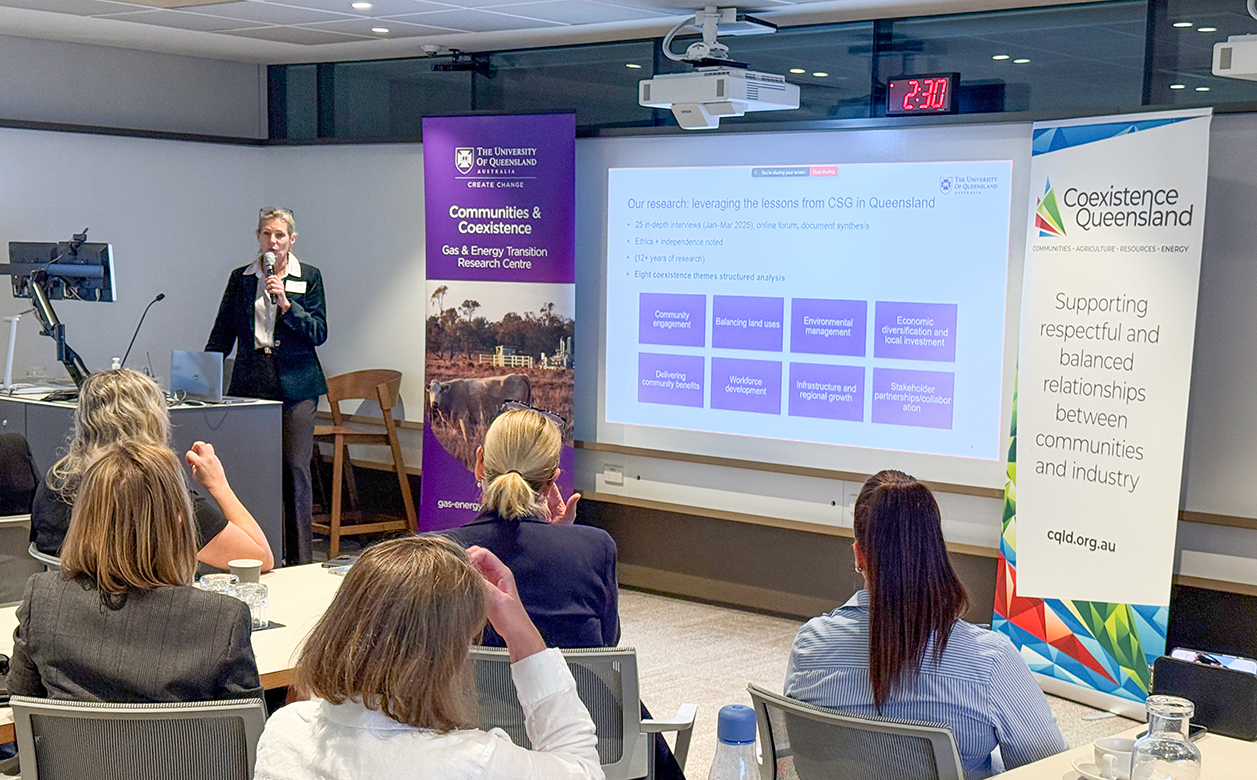
A/Prof Kathy Witt sharing the research findings with government, industry and community stakeholders.
Queensland is experiencing a new wave of large-scale energy and resource development, from renewable energy and transmission developments to critical minerals hydrogen projects. This project , which was commissioned by Coexistence Queensland, aimed to help ensure these projects' development followed 'best practice' by leveraging the lessons learnt from the analogous, rapid development of the coal seam gas (CSG) industry
Researchers identified key lessons from CSG development by reviewing documentary sources and engaging stakeholders through a variety of methods, including 25 in-depth stakeholder interviews and an open online discussion forum. Participants represented a diverse range of perspectives, including landholders, Traditional Owners, community organisations, local government, industry representatives, environmental advocates, agricultural groups and government agencies.
Drawing on these stakeholder experiences, the research identified lessons across eight key themes: community engagement, balancing land use across industries, environmental management, economic diversification and local investment, community benefit sharing, workforce development, stakeholder partnerships, and infrastructure planning.
The findings demonstrate that successful energy development depends on more than technical and economic performance. Stakeholders consistently emphasised the importance of early and respectful engagement, transparent communication, strong environmental oversight, coordinated planning, and genuine collaboration between industry, government and communities. Where these elements were present, communities were better able to navigate change and capture long-term benefits.
A recurring lesson was the importance of recognising energy projects as part of broader regional ecosystems. Rather than treating projects as isolated developments, stakeholders highlighted the need for planning approaches that consider cumulative impacts, competing land uses, workforce pressures, infrastructure demands and community aspirations at a regional scale.
The report also identifies a range of leading practices that emerged during Queensland's CSG development, including independent oversight bodies, land access frameworks, groundwater monitoring programs, community consultation mechanisms, local procurement initiatives, community benefit strategies and regional planning approaches. These examples provide practical guidance for governments, project proponents and host communities seeking to support more sustainable and equitable development outcomes.
PROJECT OUTPUTS
- Final project report: Leveraging the Lessons from the Development of the Queensland Onshore Gas Industry (2025)
|