
The UQ Gas & Energy Transition Research Centre was 'out and about' in May, with researchers using an array of external engagement opportunities to share their latest work with industry and government stakeholders.
Social performance, the role of batteries in a changing grid, carbon capture and storage (CCS) and methane quantification were just a few of the topics addressed at the enagements, which included conferences, seminars and team-to-team meetings.
If you’d like to learn more about any of the research highlighted below, contact us here.
Annual energy conference provides a stage for multidisciplinary research
Associate Professor Kathy Witt, Emeritus Professor Andrew Garnett, Dr Julie Pearce, Dr Debashish Dev, Dr Afsal Najeeb and Dr Hamish MacDonald all travelled to Adelaide for this year's Australian Energy Producers (AEP) Conference & Exhibition after being invited to share the latest findings from a range of projects.
The AEP Conference & Exhibition brings together industry leaders, government decision-makers, investors, customers and stakeholders to help form an agenda for the country's energy future.
The research showcased this year covered a wide variety of topics, reflecting the full breadth and depth of the Centre’s expertise. The projects included:
- Local Concerns to Broader Perceptions: Public Responses to CSG Brine Management in Queensland
- The market substitution argument – what can we learn from the 2020–2023 Chinese coal import bans? | Read more
- Geoscience Tracers for Potential Gas Reservoir-aquifer Leakage: 87Sr/86Sr
- Mapping Australia’s gas production history: a linked open data-based dataset for energy transition analysis
- A narrative-based framework for energy-transition consultations: insights from Australia’s future gas strategy | Read more
Research present pathway to 'gold standard' methane reporting
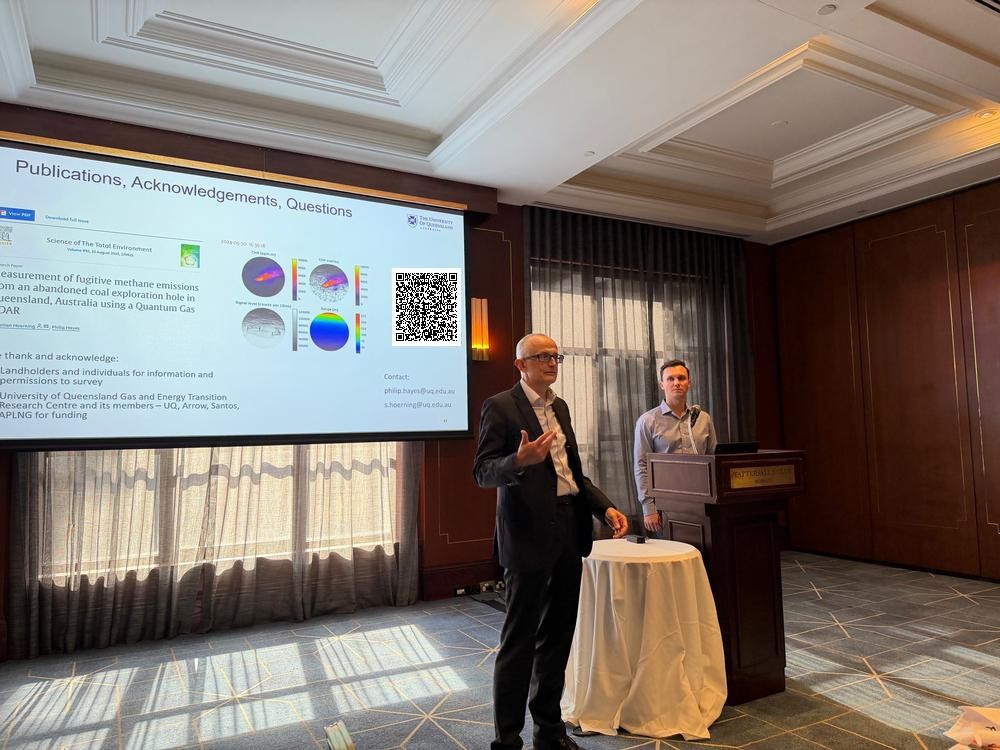 The Society of Petroleum Engineers (SPE) invited Assoc Prof Phil Hayes and Dr Sebastian Hoerning to their monthly technical luncheon to discuss an area of increasing importance to the gas industry and our Centre: methane emission.
Presenting to professionals from across the industry, Phil and Sebastian suggested that extended temporal monitoring of fugitive methane emissions is a critical step towards the industry's goal of adopting the gold standard of emissions reporting - Oil & Gas Methane Partnership (OGMP) Level 4 and 5. Phil and Sebastian supported this by reviewing bottom-up versus top-down methane quantification techniques and comparing emission behaviours across industries to demonstrate the challenges associated with monitoring emissions. They followed this up by showing how issues that limit the application of ‘snapshot surveying’, such as distinguishing natural variability from measurement artefacts, can be overcome by averaging continuous or repeated measurements across longer periods of time.
The presentation referenced ongoing research by our Centre that has been employing ground-based temporal surveys, ranging from one hour to seven days, conducted across targets that include water intake structures, gas compressor plants, and geogenic sources.
CCUS at scale in Australia
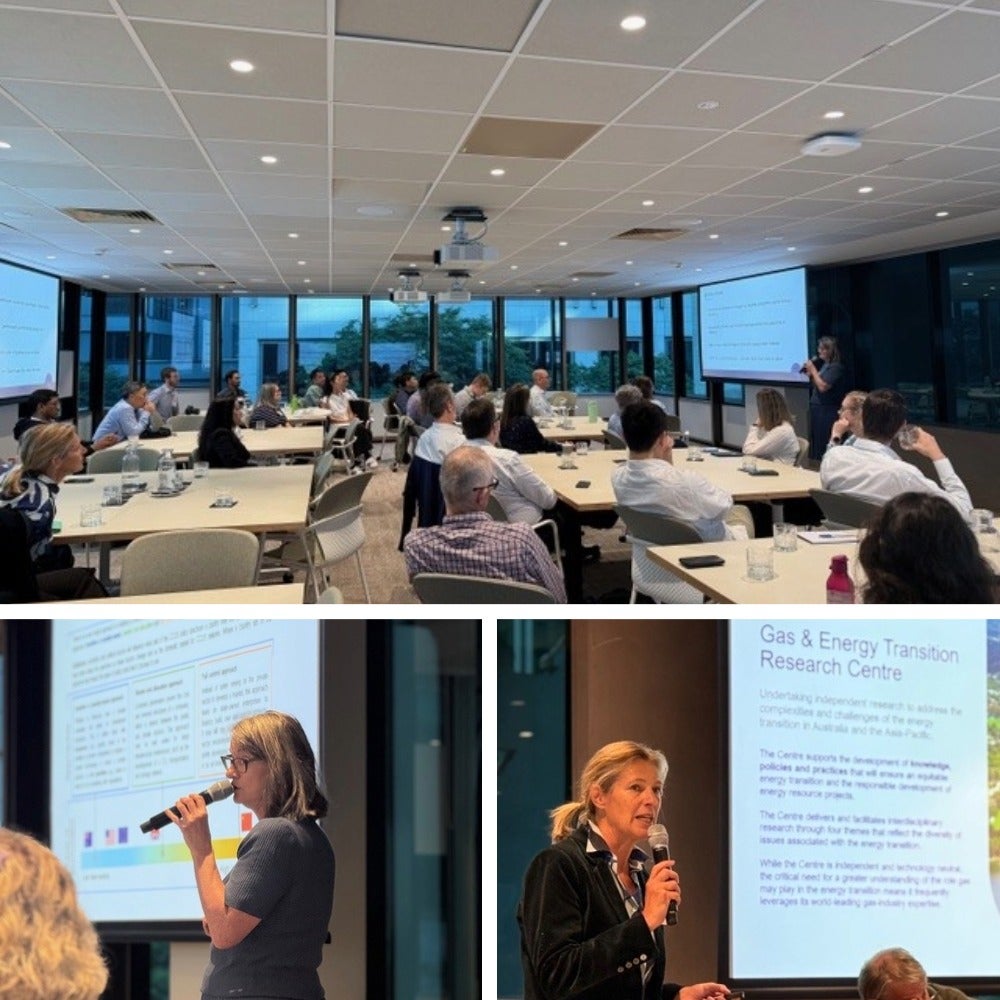 Scientists, engineers and policymakers joined Centre researchers in Brisbane City for a rare east coast opportunity to discuss carbon capture and storage at an event titled 'CCUS at scale in Australia – what is holding us back?’
The event, which our Centre co-hosted with CCUS Network Australia (CCUSNA), provided professionals and researchers with an opportunity to learn more about CCS and make like-minded connections from a range of industries. Centre Director Assoc Prof Katherine Witt kicked off the event by providing context on the current state of CCS on the East Coast and the range of research the Centre has done in this. She then handed over to CCUSNA Chair Rosie Johnstone for the main presentation. Rosie’s presentation was engaging and comprehensive, sharing information on ‘CCS hubs’, examining progress being made in Western Australia, and looking at how Australia compares with international analogues.
A key point was made clear in the presentation – Australia is falling behind when it comes to CCS. Drawing on case studies and clear criteria, Rosie outlined how Australia approaches CCS compared to governments in Europe, Asia and America, and the difference is stark. Australia is falling behind both in the application of CCS (though Santos Ltd’s Moomba project was highlighted as an Australian success) as well as the policy needed to encourage it. This is despite the Federal government highlighting CCS as important to realising Australia’s Net Zero ambitions, and particularly its role in decarbonising ‘hard to abate’ industries.
Our Centre has undertaken a significant amount of research into the social, technological, environmental and economic aspects of CCS in Australia, with the 3-year Surat Deep Aquifer Appraisal Project a particularly notable output. Both Assoc Prof Kathy Witt and Dr Julie Pearce continue their research into CCUS with Dr Julie Pearce’s work into the groundwater and geochemical reactions also continues to advance knowledge around potential environmental implications of CCS.
Battery insights shared with policymakers
 How will batteries affect pricing in the National Electricity Market (NEM)? Will their growing presence change the economics behind Gas-Powered Generation (GPG)? What will all that mean for Queensland? Those are just some of the questions Dr Afsal Najeeb explored while discussing his latest research at a meeting with Queensland Treasury policymakers.
Dr Najeeb joined our Centre in June 2025 and has since worked with numerous researchers – such as Prof Andrew Garnett and Centre Adjunct Prof David Close – to investigate the growing role of batteries in NEM and how they interface with GPG. Presenting to Treasury last week, Afsal expanded upon two of his key findings: that gas and batteries should be considered as strategic competitors, and that that reality has challenging implications for the economic utilisation profile of GPGs.
Afsal also took the opportunity to examine the possible implications of higher battery penetration in the context of the Queensland Energy Roadmap, which was released last year. Noting that the Roadmap aims to bring online 4.8 GW of gas capacity and 3.4 GW battery capacity by 2035, he posed a few key questions:
- Is there a revenue sufficiency risk in new gas projects?
- Do we need to distinguish GPG capacity for security and regular dispatch?
- Is there a deliverability challenge? Can gas be delivered to GPGs when required, at the very high rates it might require in the future?


